

The styles, the well-marked tenses
The observation of more than 1200 works created by Henri Bouchard and the exhibitions organized around his work, allowed us to identify characteristics with well-marked expression modes.
These different stages mark the artist’s journey, and characterize his 'styles'.
Training
Fellow at the School of Fine Arts in Dijon, (1989-1894), he obtains a new scholarship allowing him to go to Paris, and to attend the courses of the Julian Academy and the School of Decorative Arts in 1894. There he prepares and succeeds the competition of the School of Fine Arts in Paris (Barrias workshop).
In the 19th century, the Beaux-Arts trained students to search for truth in their plastics representations (surface anatomy, studied draperies, faces with well-marked expressions, mythological subjects, or religious...).
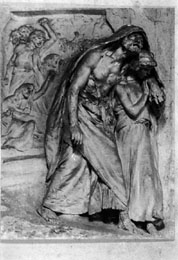
Oedipus and Antigonus driven out of Thebes (1901)
Prix de Rome
In this composition, Bouchard showed in both high and low relief that he had really assimilated academic teaching.
The expressive heads of Oedipus, the old blind man, and of Antigone, his daughter, with a soft and compassionate face.
The treatment of drapery, the naked torso of the old man and the supple arms of the young girl, the composition of different spaces, contrasting the foreground in high relief and the background in low relief, and the changes of scale.
Realism of the beginnings
The Villa Medici in Rome requires boarders to send a work to Paris each year referring to Antiquity or the Renaissance. The artist is passionately interested in the subjects of his environment in Italy and during his travels: he studies the peasants of the Roman countryside, the workers and artisans, scenes from North Africa, the Spanish dancers, ...
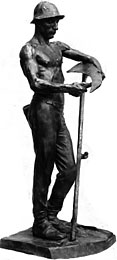
Reaper sharpening his scythe (1903)
He sends in the second year a realistic work poorly perceived by the members of the Academy of Fine Arts: (the anatomy is masked by the trousers. It is finally accepted for its great sculptural quality.
The studies carried out in those years are characterized by a very strong realism, going to the essential.
Search for stripping
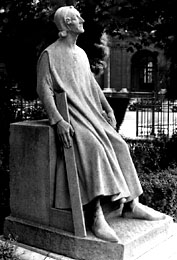
Pierre de Montereau (1908)
It represents the character (an architect from the Middle Ages who created the Sainte Chapelle and the Abbey of Saint-Denis), sitting on a column base, in his construction site, the ruler and compass in hand, looking towards a building.
The simple treatment by large plans, the wide folds in the draperies, have the effect of directing attention on the more detailed face.
The search for simplification is very clear here. He write to one of his friends: "My Pierre de Montereau is completed, it’s a curious statue, but so simple that it seems poor and I am convinced that she will have no success ».
Exhibited at the Grand Palais in 1908 at the Salon des Artistes Français, it was on the contrary an immediate success.
Monumental Style
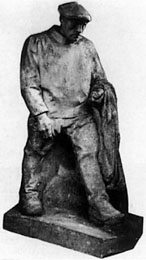
Breton Fisherman (1909)
In 1909, the artist continued his search for simple forms on a more massive scale.
"... to speak of only the essential and to talk of it with all possible truth, to attain at the same time the 3-dimensional beauty of the planes, the volumes and the silhouettes are my present objectives."
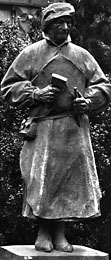
Claus Sluter (1911)
1911: Research into monumentality, simplification.
"...there is not only the costume, there is the search for plans holding or making the light run, of the beauty of volumes, of the quality of the accents, finally of almost everything that makes our language to us sculptors who have forgotten it and whose beauties can be relearned by our good imagers of the Middle Ages despite their appearance of an apparent ugliness."
Decorative Style
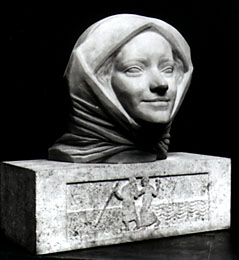
Madame Bouchard (1913)
In his desires for stripping, he seeks the decorative side.
"My research is then more and more towards decorative plastic, acting as architecture by its construction, by its volumes, its decorations, its games of plans to achieve whatever the subject expresses an aspect interesting for the eye and mind of the viewer..."
Decorative art of the 30's
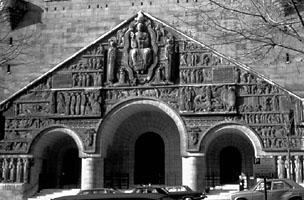
Church of Saint Pierre de Chaillot (Paris 1933-35)
He continues through numerous commissioned works, his decorative research.
His style while remaining very decorative then involves less geometrization, more curves, his characters have more flexible attitudes.
Return to Interpreted Realism
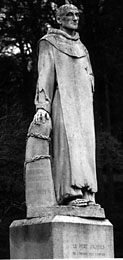
Father Jacques (1948)
(who died in a concentration camp)
The Second World War interrupted his research. He then had fewer orders and retreated to topics related to his native Burgundy.
He returns to a less geometrized decorative style while keeping his sculptural design with simple large planes.
Around 1950, he was then 75 years old, perhaps in reaction against the new generation who embarked on abstraction, he returned to a stripped-down realism.